October 14th
I invite Veryan to accompany Steve and myself to the pond and identify the plants around the site. Living in the village, she’s a geographer with a deep knowledge of flora and fauna in the fields around Coleford.
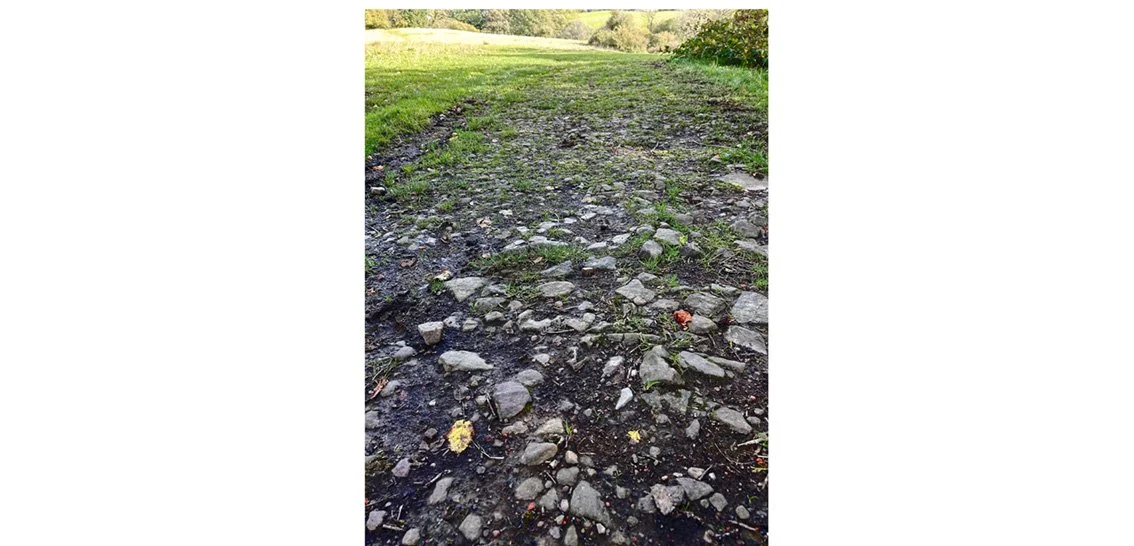
We make our way along an old track that 200 years ago would have echoed with the tread of miners’ boots and creaking carts carrying coal. Sections are still lined with small rough stones; if I search I’ll probably find coal fragments.
It’s a sunny, slightly chilly morning; a herd of cows is meandering slowly about in the field. An old bull with a ring in his nose stands on a rise above the track surveying the land, and us; I greet him as we walk past, he stares back. Just as we are entering the wood I hear a familiar bellowing and stop, I know who that is. Glancing back, sure enough it’s number 680483, the black cow I encountered on a recent visit. Trotting briskly down the field, she is followed by a neat-ish line of ambling young cows and bullocks; she’s clearly the matron of the herd and they know their place.
Still no water in the pond, but it feels softer underfoot and pools of rain water sit in deep ruts. Veryan is looking closely at the ground, both in the ponds and around the edges, pointing out and identifying plants while I rapidly scribble down names and photograph, and recording our conversations.
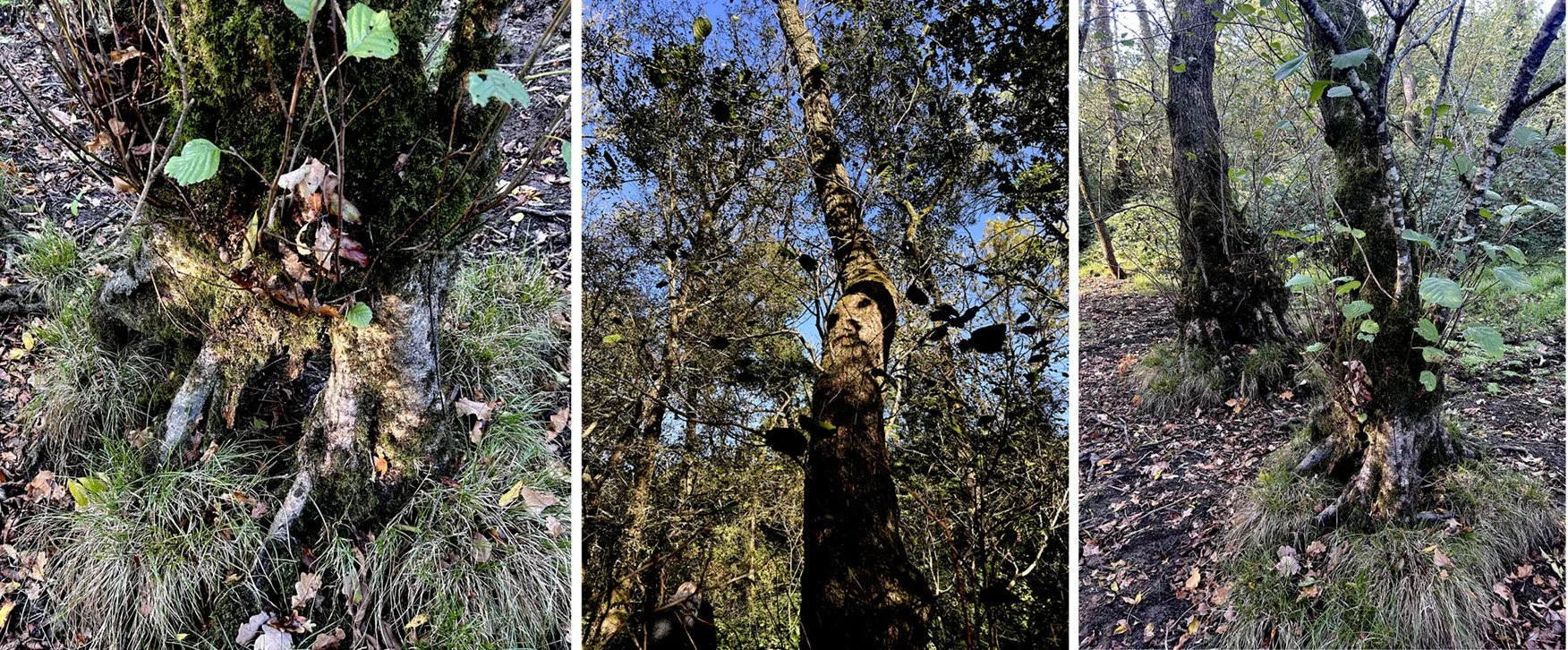
Alder
Two trees sit in the centre of the dry pond, their thick roots splayed out, anchoring the trees deep into mud; these are Alders (genus Alnus), members of the birch family (Betulaceae). They thrive in wet or waterlogged soils, which is what they are doing here - last winter they were surrounded by the pond water, their roots well and truly saturated. They useful fixers of nitrogen in the soil via root symbiosis, and produce woody, cone-like fruits. Soft and porous, alder wood is only durable if kept wet - it can withstand rotting in water. It’s a very versatile tree; historically, used make clogs, gunpowder and charcoal, as well as the construction of boats, sluice gates and water pipes. Its bark used for tanning – soaked with iron it produces a black ink for writing, and dyeing wool and linen. ranches have been used to make whistles and panpipes, and the wood is still used in guitars - acoustic necks and electric guitar bodies. I look at the trees with great respect.
We wander about and find edible plants, grasses, mosses and ferns – some identified by the way the fronds at the base of the stem curl or bend, others that need looking at under a microscope to work out the exact genus.
There are a mass of different ferns and mosses –

Lady Fern
Common feather moss
Common tamarisk-moss
Common or Western polypody
Wood fern male fern
1 Lady fern (Athyrium filix-femina) a common, graceful, deciduous native fern found across damp woodlands, shaded stream banks, and hedgerows. It grows up to 90 cm to 1.2m tall, with soft, finely divided, bright green lacy fronds.
2 Common feather moss (Kindbergia praelonga) with delicate, highly branched, fern-like or feather-like fronds. Its stems are regularly divided, giving them a soft, intricate texture.
3 Common tamarisk-moss (Thuidium tamariscinum) a beautiful species of moss with fern-like tri-pinnate flattened branches.
4 Common or Western polypody - a hardy fern of damp, shady places in woodlands. (Veryan is not sure which one this is).
5 Wood fern male fern (Dryopteris filix-mas) a common, hardy, deciduous native. A large, clump-forming fern common in woodlands, hedgerows and ditches. Male-ferns are identifiable by looking at how the fronds grow - separated into tapering leaflets, deeply divided, coming out from the main stem in opposite pairs.
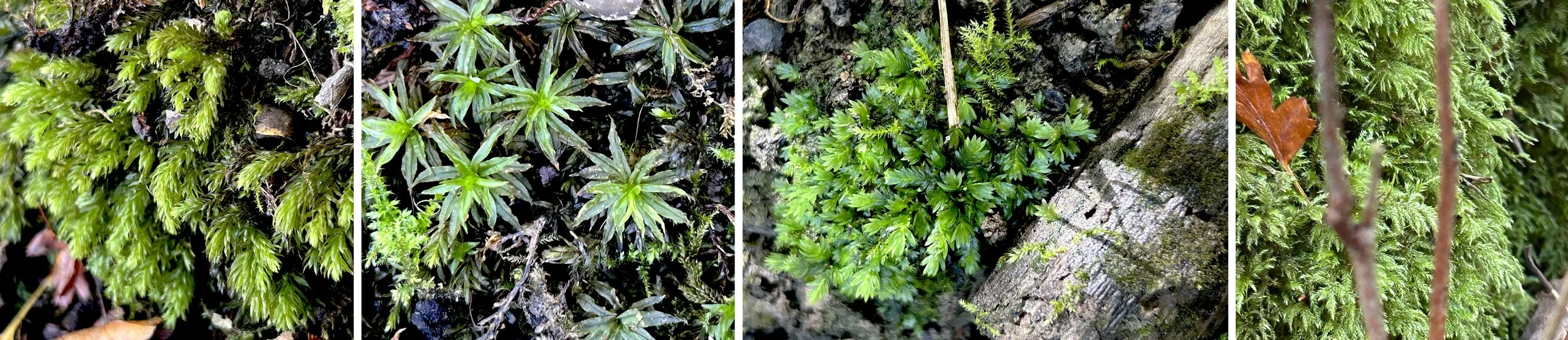
Swans Neck Moss
Catherine’s Moss
Common Pocket Moss
Fox-tail Feather-moss
1 Swans Neck Moss (Mnium hornum) also called Swan's-neck thyme-moss - one of the most common UK woodland mosses. With dark, dull-green velvety shoots, distinctive toothed leaf borders, and arching spore capsules that curve like a swan's neck. With tufts 2–4 cm tall it grows on acidic woodland floors, tree bases, logs, and stream banks.
2 Catherine’s Moss (Atrichum undulatum), named after Catherine the Great, it’s found in shaded, well-drained woodlands; usually dark green, but sometimes yellower when well-lit.
3 Common Pocket Moss (Fissidens taxifolius) a small to medium-sized moss that grows in dense, yellowish-green to dark green tufts. Characterised by its distinctive flattened appearance, with leaves arranged in two opposite rows resembling tiny fern fronds, and pointed leaf tips with projecting central nerves.
4 Fox-tail Feather-moss (Thamnobryum alopecurum) dendroid growth form – no other woodland moss has a blackish ‘stalk’ devoid of true leaves below a bushy ‘canopy’ of secondary shoots. This moss can detach itself from the ground and roll around like tumbleweed.
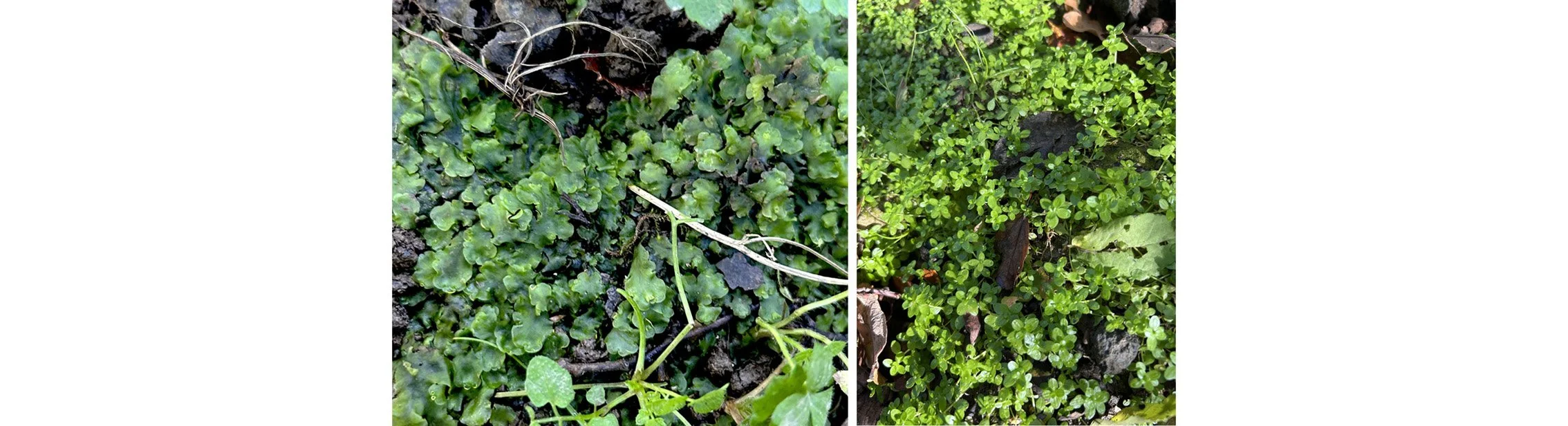
Liverwort and Starwort
Liverwort (Pellia epiphylla) sits on the ground under the ferns; instead of having stems and true leaves like mosses, grow as a flat, ribbon-like green sheet called a thallus. Thrive in wet, shaded environments such as stream banks, damp soil, or moist rocks.
Pond Water Starwort (Callitriche) is growing across the pond’s base, unimpeded by water. An oxygenating plant, its pale green leaves are linear when submerged, forming starry masses where they reach the surface. Callitriche is also good for providing a sheltered habitat for fish and wildlife. The submerged leaves are particularly favoured by newts and as a place to lay their eggs (and maybe frogs too, since I found tadpoles here earlier in the year).
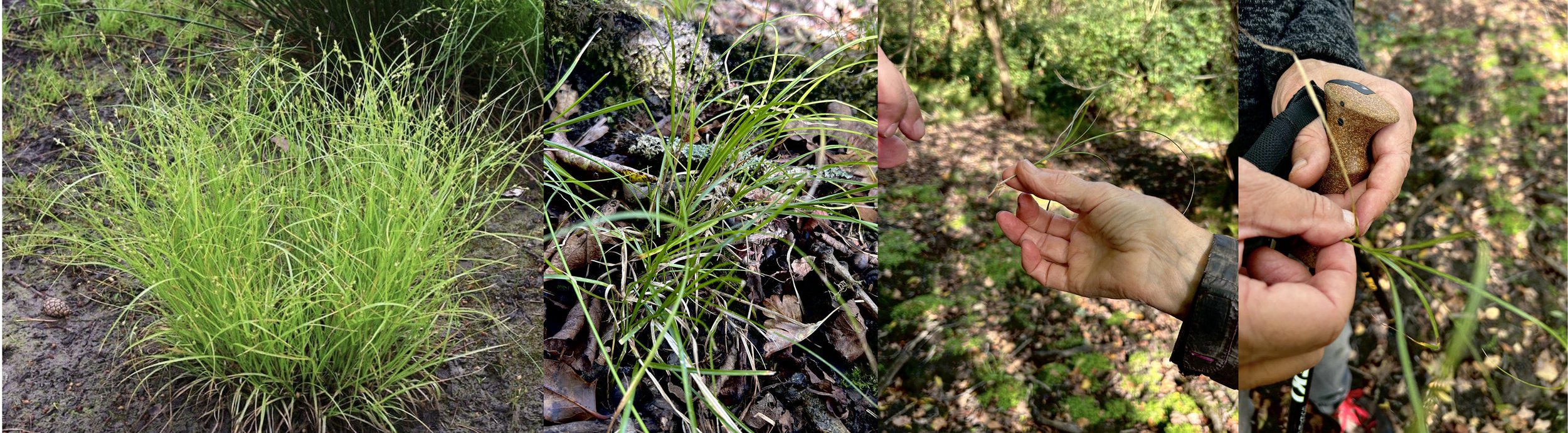
Remote sedge with flower heads
There’s a cluster of rather tattered flower heads of Remote Sedge (Carex remota), a native tufted perennial herb of damp woodland and woodland rides, often growing in shade. Favoured habitats, such as in woods that are seasonally flooded, it thrives in damp wet moist conditions, growing ponds, ditches and riverbanks.
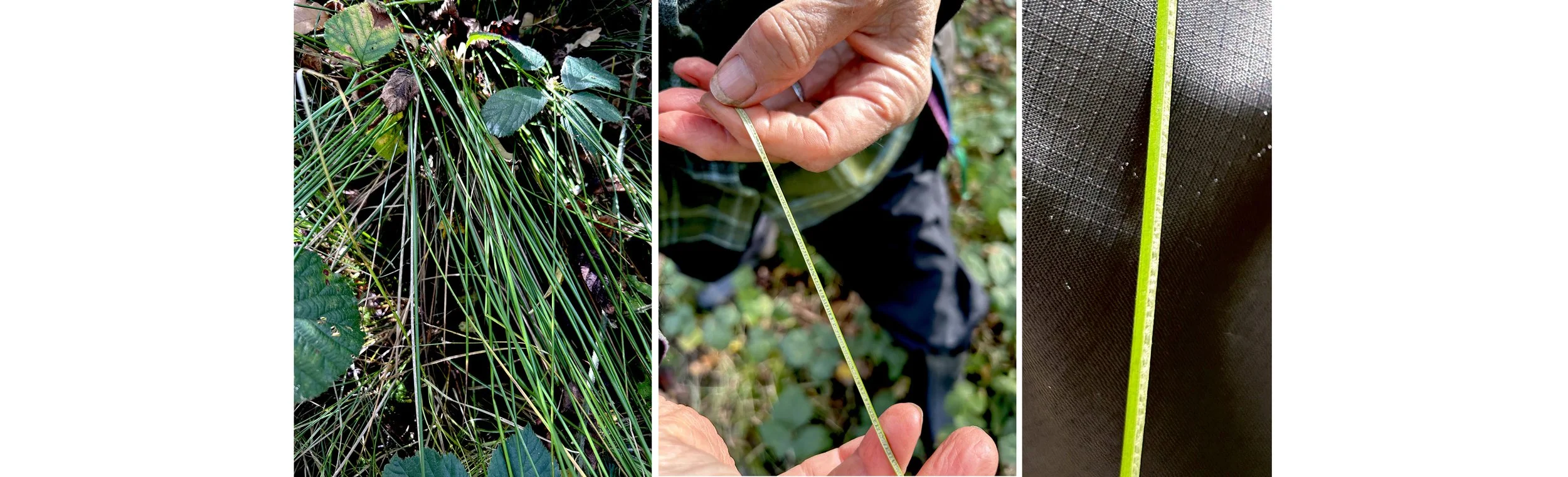
Soft rush
Clumps of Soft rush (Juncus effusus) lie almost horizontally across the ground. Thriving equally well in moist conditions or in shallow water, it’s a resilient plant, standing up well to wildfowl (and presumably cows), useful for improving the habitats for wildlife. Veryan identifies it by splitting one of the grass stems, exposing a slightly woolly structure.
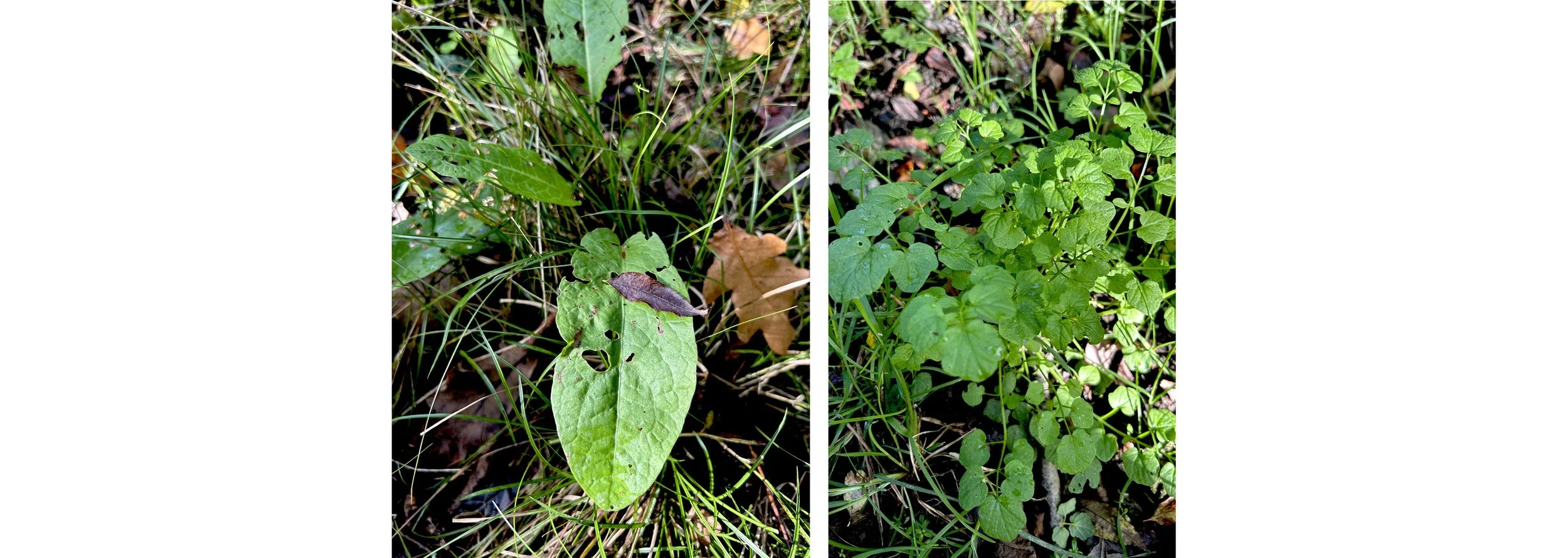
Wood Dock and Wavy Bittercress
Sitting amongst the grasses is Wood Dock (Rumex sanguineus) our only shade-tolerant dock, a short-lived, native perennial of woodland margins, clearings and rides, hedgerows and road verges. It favours damp, clayey conditions, which is what we have here.
And Wavy Bittercress (Cardamine flexuosa) a common native belonging to the mustard family (Brassicaceae). It thrives in damp, shaded spots like stream banks, ditches, and garden soil, and known for shooting its seeds out of explosive pods. Or though my phone plant identifier says that it might be Hairy bittercress (Cardamine hirsuta) - but I think I’ll go with Veryan’s suggestion. Maybe we can eat this plant?

Farinose Cartilage Lichen White Lichen Lepraria
I find a few lichen, although there are probably more if we hunt about - there’s rather delicate one - Farinose Cartilage Lichen (Ramalina farinacea) - a fruticose lichen species that forms pale, shrub-like tufts on tree branches and bark. Silvery grey-green to pale yellowish-green on both sides. Large patches of a white lichen are growing on the rough bark of a tree trunk. Veryan thinks that it’s probably Lepraria species. Lichen are difficult to identify; she tells me that experts carry small bottles of chemical to test for certain ions.
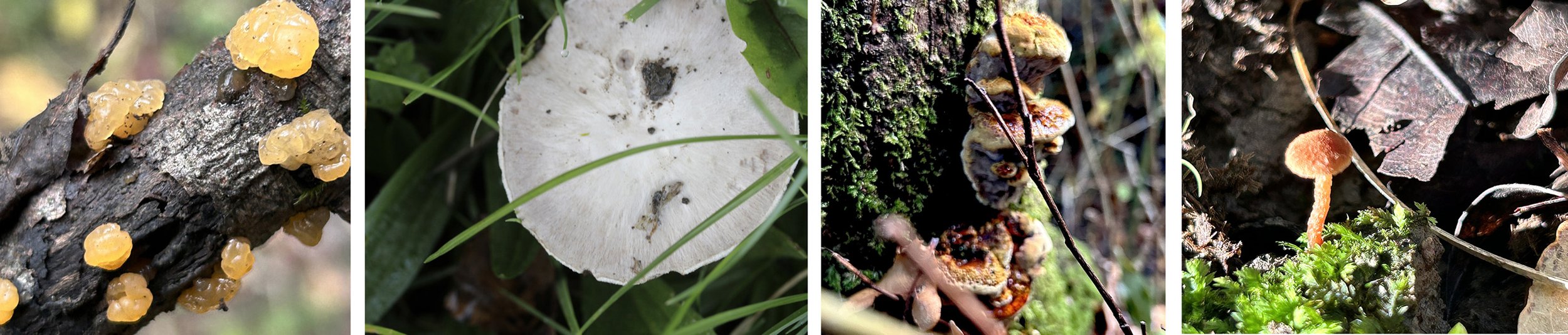
Jelly fungus Field mushroom Oak bracket small unknown toadstall
I pick up a branch and find some strange brain-looking orange lumps - Jelly fungus (Dacrymyces stillatus) also called Witches butter, it grows on dead or almost dead logs and branches. Just on the outskirts of the wood, almost hidden in the grass is a pale grey fungus - probably a field mushroom (Agaricus campestris), though for a positive identification I should check the gills and stem. I leave it where it is, there will be a lot more fungus in the woods to discover. On the side of a tree a bracket fungus that might be oak bracket (Pseudoinonotus dryadeus), and a tiny orange capped toadstall sitting amongst the decaying leaves - I have no idea which one it is.
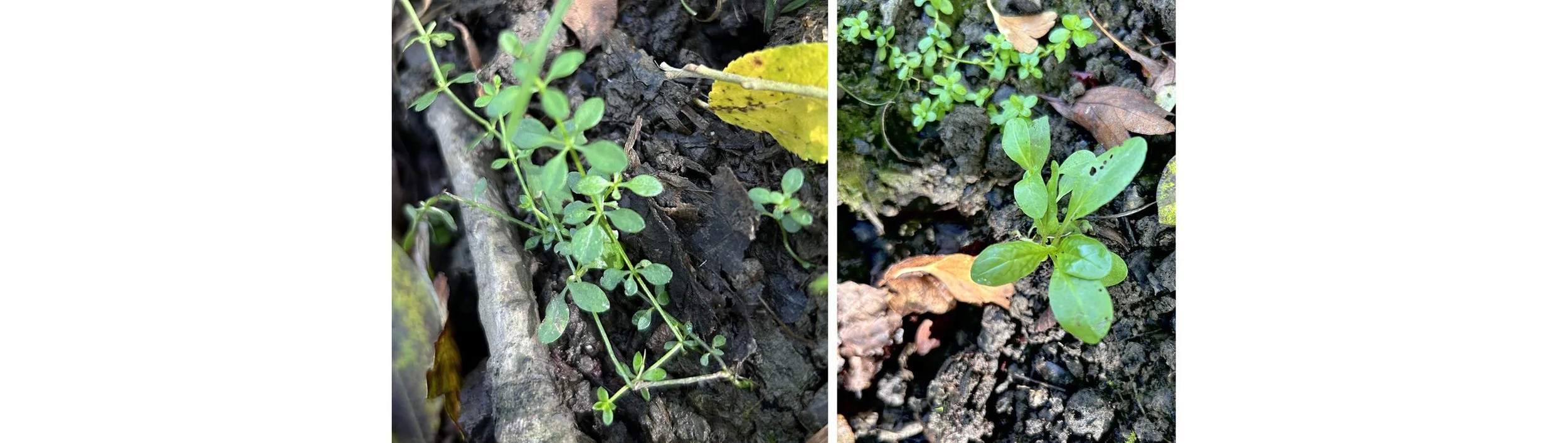
Bedstraw and Speedwell
Lying together amongst the fallen leaves and twigs are two tiny plants:
Bedstraw (Galium) - not sure which one, Veryan thinks it’s Cleavers (Galium aparine). Also known as Sticky Willy, it’s a creeping straggling plant with sticky hooks, although at the moment there’s not much of it. I discover that it can be used for relieving congestion in the body, as well as skin conditions and urinary tract infections. It has a cucumber-like taste when infused in water, can be used in cooking, and also provides food for the caterpillars of butterflies and moths. And Brooklime Speedwell (Veronica beccabunga), a semi-aquatic plant from the Speedwell family, often found growing in slow-moving water and damp habitats. Apparently it’s also edible.

Stinging nettle and Creeping buttercup
There are, of course, the usual clumps of common stinging nettles (Urtica dioica), which have a preference for damp, fertile and disturbed ground. Much as we all find them annoying when we brush up against them, Stinging nettles are great wildlife attractors; caterpillars of tortoiseshell and peacock butterflies use them as food plants; ladybirds feast on the aphids that shelter among them; and seed-eating birds enjoy their autumn flower heads. Creeping buttercup (Ranunculus repens) an herbaceous perennial and common native wildflower, found in damp grasslands, gardens, and waste ground, spreading, as all gardeners know, rapidly via underground and surface runners

Common Ivy and Common Holly
Common ivy (Hedera helix) winds its way over the ground and around the trees. A native widespread plant, found in many habitats, including woodland, scrub, wasteland, parks, gardens and on isolated trees. Tolerant of shade, it survives in all but the most dry, waterlogged, or acidic soils. In amongst all this is Common Holly (Ilex aquifolium), thriving in moist, shady environments. It seems to have had its familiar red berries all year. it’ll feed the birds and, if there’s any left at Christmas, will decorate the house.
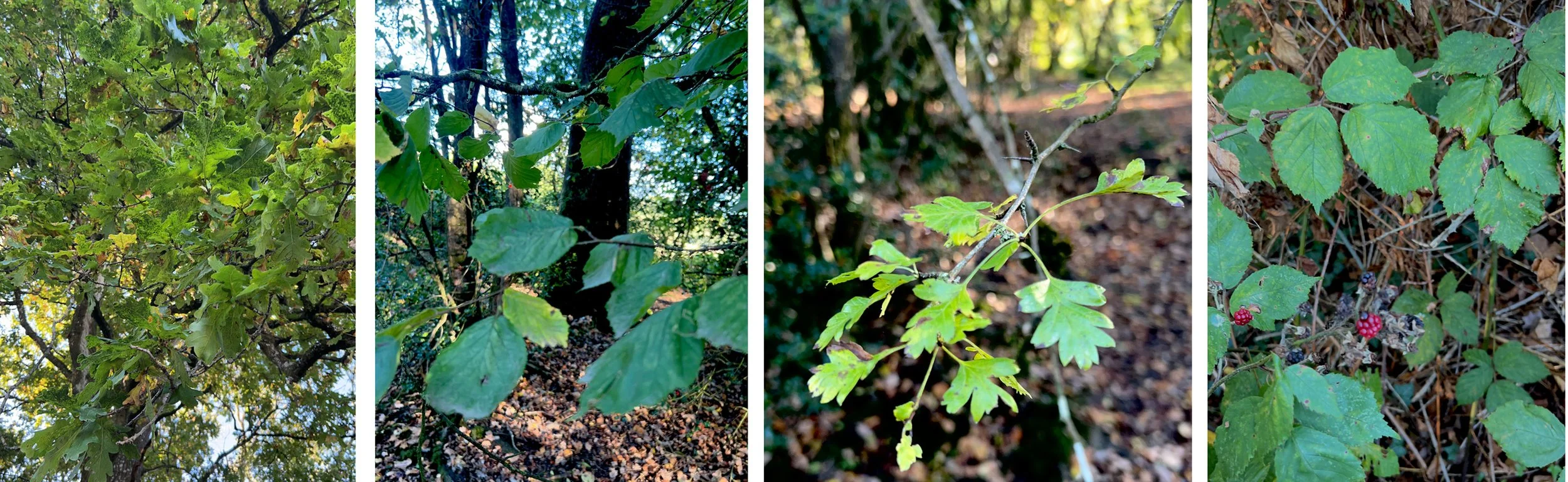
There are also different trees and I’ve probably missed a few: Oak (Quercus robur), Hazel (Corylus avellane) Common Hawthorn (Crataegus monogyna), also known as whitethorn or May tree, are all growing in the wood around the pond. I must look out for hazel nuts, although the squirrels have probably already grabbed them all. Wild brambles (Rubus fruticosus) grow underneath them, still with the remnant of late black berries.
I am amazed at the variety of plants growing here in this tiny area that I have overlooked; up to know I’ve just passed by and seen them just as more green leaves. I’m particularly impressed that a lot of them are edible. There will be others that will appear and to identify in the spring
There’s a new deep rut in the pond bed where a cow has wandered through and sunk into the mud. It shows pale brown clay mixed in the earth. I worry that the pond will never fill again; Veryan observes that given it was dug a couple of hundred years ago and was once much deeper, it will probably completely disappear in the next 10 years as more and more silt from decaying leaves and earth wash into it. I feel sad at this thought, but I think it will always be a boggy area.
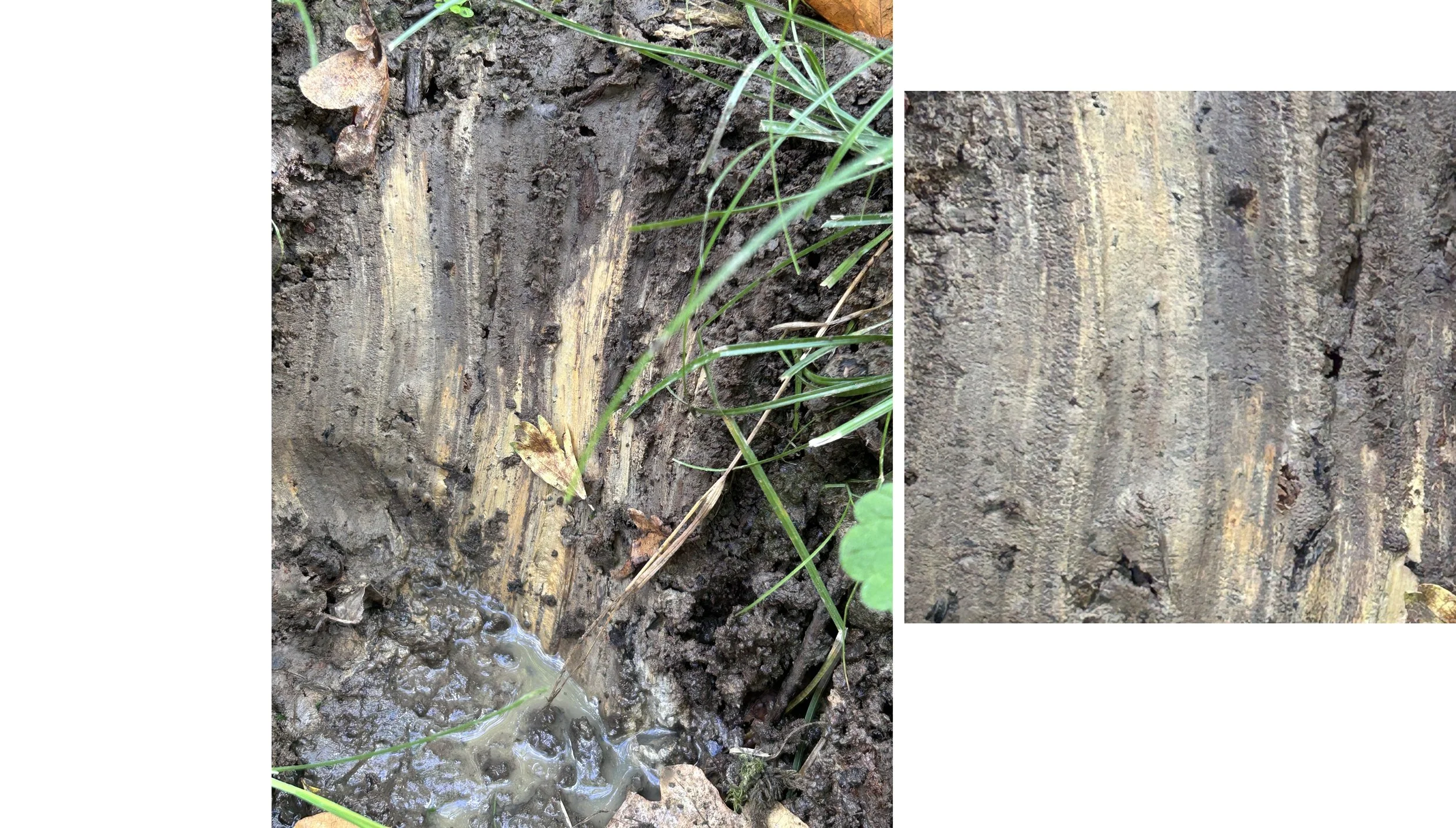
Section through the pond’s soil bed
Leaving the shade of the wood we walk out into the sun. Veryan points to where she knows violets will be growing next year - the soil here in this raised flattened section being chalky (formally the old site of mine buildings, fragments of bricks lie amongst the trees). The cows are still in the field, grazing or sitting sleepily in the sun. We encounter the bull who’s taken himself off to a small gap between two fields, perhaps for a quiet moment on his own. He has his back to us and seems to be stuck in the thicket. He’s only a few feet from us so I stop and ask if he needs any help. After some rather vigorous shakes of his head he manages to free himself from the brambles and lumbers round to face us. I ask if he’s okay now; he looks steadily at us and seems uncertain, we wander on. Veryan remarks that probably no-one has ever spoken to him like that before.
Thoughts
I’m not quite sure how all this new knowledge will feed into my developing work, but it is another aspect of my deep encounter with the pond. This pond is not a passive subject waiting to be understood. It is an active place I am encountering – changing and evolving – and I am learning to read it. As Doreen Massey suggests when writing about the elusiveness of place, place is not simply a thing but 'a constellation of processes' (For Space, 2005, p. 151). Massey understands place as a coming together of different histories, processes, relationships and encounters, involving both human and non-human elements. The pond is not simply a geographical feature; it is a constantly changing meeting place of ecological, historical and temporal processes. ‘This is place as open and as internally multiple’ ( p. 151). I now have the addition of Veryan’s knowledge of plants - making me more aware of the environment and the significance of what the pond supports and is growing here - as well as my research about the histories and processes of changes that have occurred here. Knowing that 200 years ago this pond was created to serve an industrial process – a human-made feature that has now become a habitat - raises questions about how and what has happened here, what still remains unknown, and what is to come.
Abandoned and left to do its own thing when the mine closed, the wet conditions have created a distinctive habitat, and the plants tell a story - are part of the on-going story. They tell us something about the conditions in and around the pond, I don’t know if any might have been introduced, deliberately or accidentally? My guess is that a lot of, maybe all the plants have arrived accidentally, colonising it naturally. 200 years ago there wasn’t a woodland here, so it would have looked very different; plants and pond's environment has changed over time. Depending on the species, they indicate water depth, wetness, shade, disturbance, changes in water quality. Where they grow, where they do not, how they cluster, all suggests the water's edge. As Veryan remarks, we would expect to see most of these plants here. The pond dried up this summer; I don’t know if this is a regular occurrence, or because of our changing climate and this year’s long summer months with no rainfall. How this will impact upon the environment around remains to be seen.
This is an extract from the conversations I recorded between Steve, Veryan, and myself as we walked around the pond on Coal Barton Plantation. Thank you to Veryan for her copious knowledge of plants and gentle observations about the pond.
Conversations around the pond in Coal Barton Plantation between Veryan, Steve and Janette
